Notes from
the team.
Practical work templates, assistant buying guides and documented tests from the people building Brainmox.
From everyday work
to something you can use.
See the setup, the request and the result. Take the templates with you.
 Email replies
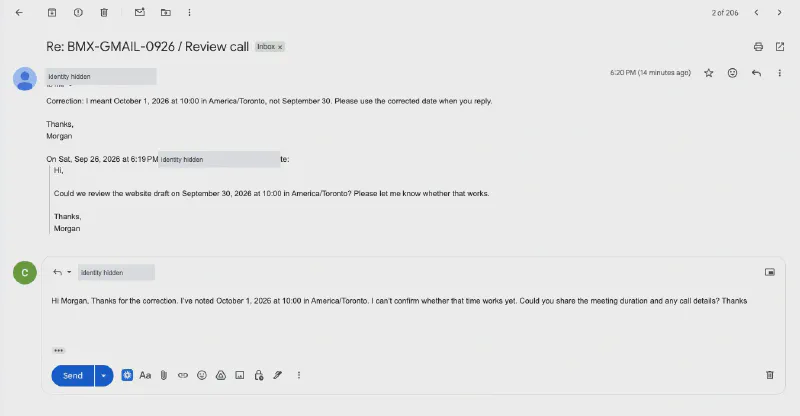
From email threads to ready-to-review replies
Follow the Gmail setup, the request to Brainmox and the actual saved drafts.
See the drafts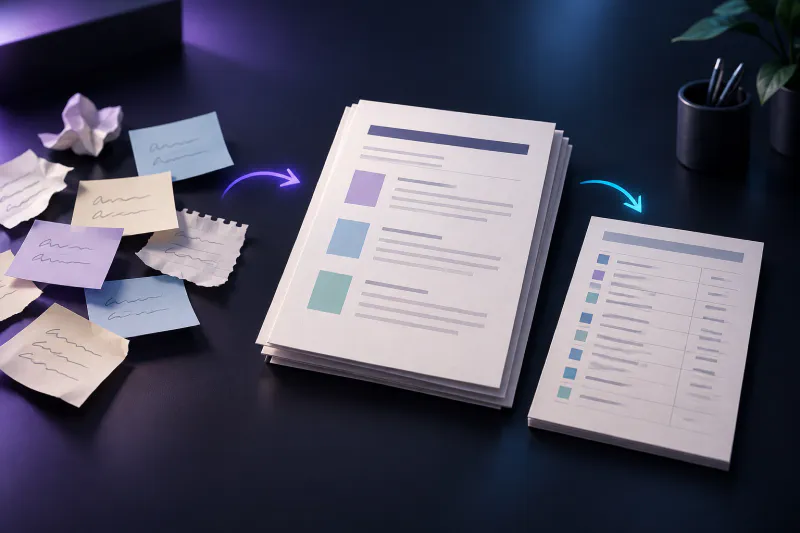 Weekly reports
From project updates to a client report
See the original Word report and task ledger, then download a template for your own work.
Open the report Meeting follow-ups
From meeting notes to clear next steps
Follow the notes into an action list, with owners, deadlines and details still to resolve.
Explore the exampleMore templates, buying guides & product details
Work templates
Start with a usable resource and check it against your own work.
- Open house sign-in sheetPrintable PDF, private cards, Word and CSV, with consent wording and a 24-hour follow-up plan.
- Five small-business AI workflowsInputs, steps, outputs, review criteria and a workflow-selection checklist.
- Action-items template and worked exampleBlank CSV, Markdown checklist and a documented meeting-notes test.
- Weekly report template and completed exampleOriginal Brainmox Word report and CSV, source notes and review findings.
- Client follow-up email examplesSix copyable drafts, a downloadable pack and a factual review exercise.
Choose an assistant
Work out what you need, what to verify and whether the offer fits.
- Compare AI executive assistantsBriefings, follow-ups and recurring admin work, with a copyable morning brief.
- Compare AI assistants for workChoose by task, documented capabilities, cost and review needs.
- Compare Manus AI alternativesDocuments, connected-app work, runtime needs and a practical switching test.
- Compare OpenClaw alternativesManaged and self-hosted choices, with a three-task evaluation.
- Agent, chatbot or copilot?Three work examples, a capability matrix and a decision worksheet.
- Evaluate an assistantA practical scorecard for your own tests.
- Is Brainmox worth $299?A local cost calculator and worksheet that counts setup and review time.
Product evidence
Read a documented test and learn how to check memory and privacy.
- Inspect the meeting-notes testOriginal and revised files, corrections and limits.
- Test persistent memoryWhat to verify across conversations.
- Review Brainmox securityPublished data-handling and access boundaries.
Free Open House Sign-In Sheet (Printable PDF, Word and CSV)
Free open house sign-in sheet: printable PDF, Word and CSV. Includes email and text consent wording, safe questions to ask and a 24-hour follow-up plan.
All
posts.
AI Assistants for Work: Compare Tools by the Job You Need Done
Choose an AI assistant for work by the task: Gmail drafts, calendar planning, documents or recurring workflows. Compare real options, costs and review needs.
AI Executive Assistants: Compare Tools for Recurring Admin Work
Compare AI executive assistants for briefings, calendar preparation, email drafts and reports. See tool choices, costs and a practical recurring-work example.
Manus AI Alternatives for Research and Recurring Work
Compare Manus AI alternatives for documents, connected-app tasks and recurring work. Check costs, runtime requirements and a practical switching test.
OpenClaw Alternatives: Managed and Self-Hosted AI Assistants
Compare OpenClaw with Brainmox, Claude Cowork, Manus and Lindy by setup, work tasks, cost and control. Includes a practical three-task evaluation.
Follow-Up Email After No Response: 6 Client Examples
Copy six client follow-up emails for approvals, missing documents, feedback and next steps. Includes a downloadable pack and a draft-review checklist.
Weekly Report Template: A Real Brainmox Example
See Brainmox turn six fictional project notes into a weekly Word report and CSV ledger. Download the original files, blank templates and review checklist.
Action Items Template: Turn Meeting Notes into Next Steps
Use an action-items template with owners, due dates and source notes. Includes a worked example, a reusable prompt and a documented Brainmox test.
AI assistant evaluation scorecard: a practical worksheet
Score an AI assistant on one real workflow, with evidence for outcomes, memory, permissions, recovery, privacy and review—not feature-page promises.
Is Brainmox worth $299 a month? A workflow cost worksheet
A worksheet for deciding whether Brainmox is worth $299 a month for your recurring work: count setup, review and corrections, use your own numbers, and see when it does not pay off.
Building Brainmox: Why We Made Privacy Non-Negotiable
An AI agent that reads your files and works your inbox needs a higher privacy bar than a chatbot. The five rules we build Brainmox around, and why.
What a stable identity adds to an AI agent
A stable agent identity can make multi-channel work easier to recognize and review—but it does not replace memory, permissions or human accountability.
Why an AI says “I don't know”—and how to diagnose it
An AI may lack the source, fail to retrieve it, face a permission boundary, or be uncertain. Here is a practical way to find the actual cause.
How to keep an AI agent loop from running up costs
A practical look at repeat-call detection, idempotency, call budgets and audit logs—and the limits of each control.
AI Agent vs Chatbot vs Copilot: A Practical Buying Guide
Compare AI agents, chatbots and copilots through three work examples, a capability matrix and a downloadable decision worksheet.
What persistent AI memory means—and how to test it
AI products use the word memory for different systems. Learn the practical distinctions and test recall, provenance, correction and deletion yourself.
The AI assistant test: 12 capabilities to verify before you buy
A vendor-neutral test for memory, scheduling, tools, permissions and auditability—based on a real workflow rather than a feature-page checklist.