
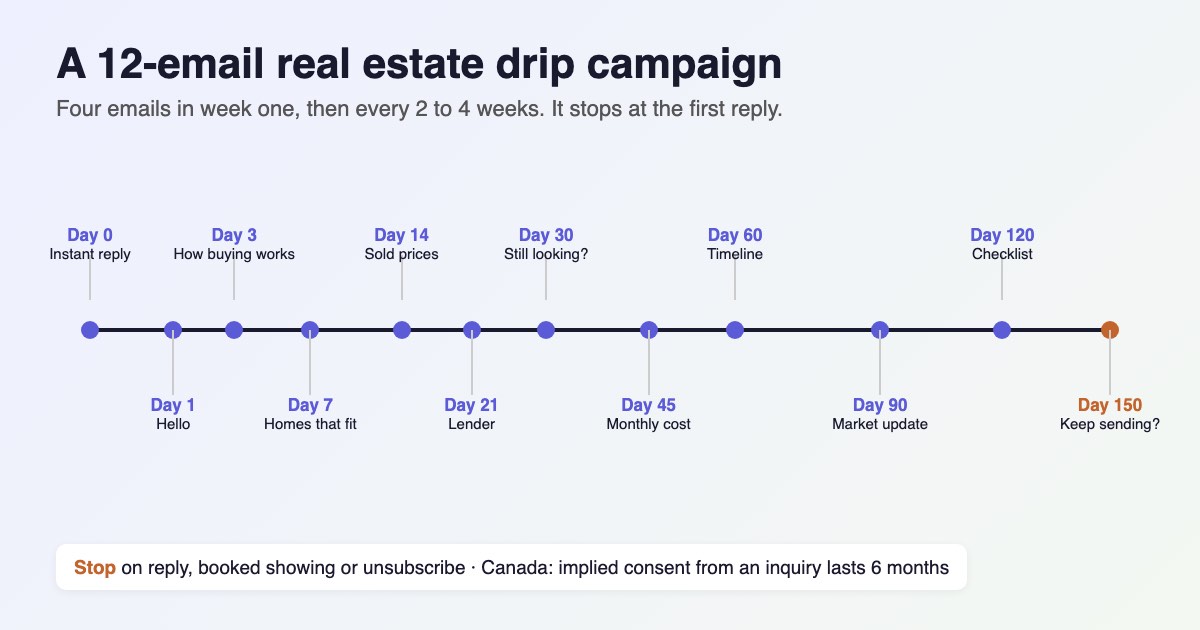
A real estate drip campaign is a set of emails your email tool or CRM sends a new lead on a schedule, so nobody goes quiet just because you got busy. This one has 12 emails over 150 days: four in the first week, then one every two to four weeks. Every email is useful on its own, asks one question, and the whole drip stops the moment the lead replies. Below is the timing, the full copy for buyer leads, the swaps for seller leads and the consent rules in the US and Canada.
Download the drip campaign (free, no signup)
- All 12 emails (Word): edit the brackets, then paste into your email tool
- All 12 emails (PDF): print it or keep it open while you set up
- Send schedule (CSV): one row per email with the send day, subject, goal and stop rules
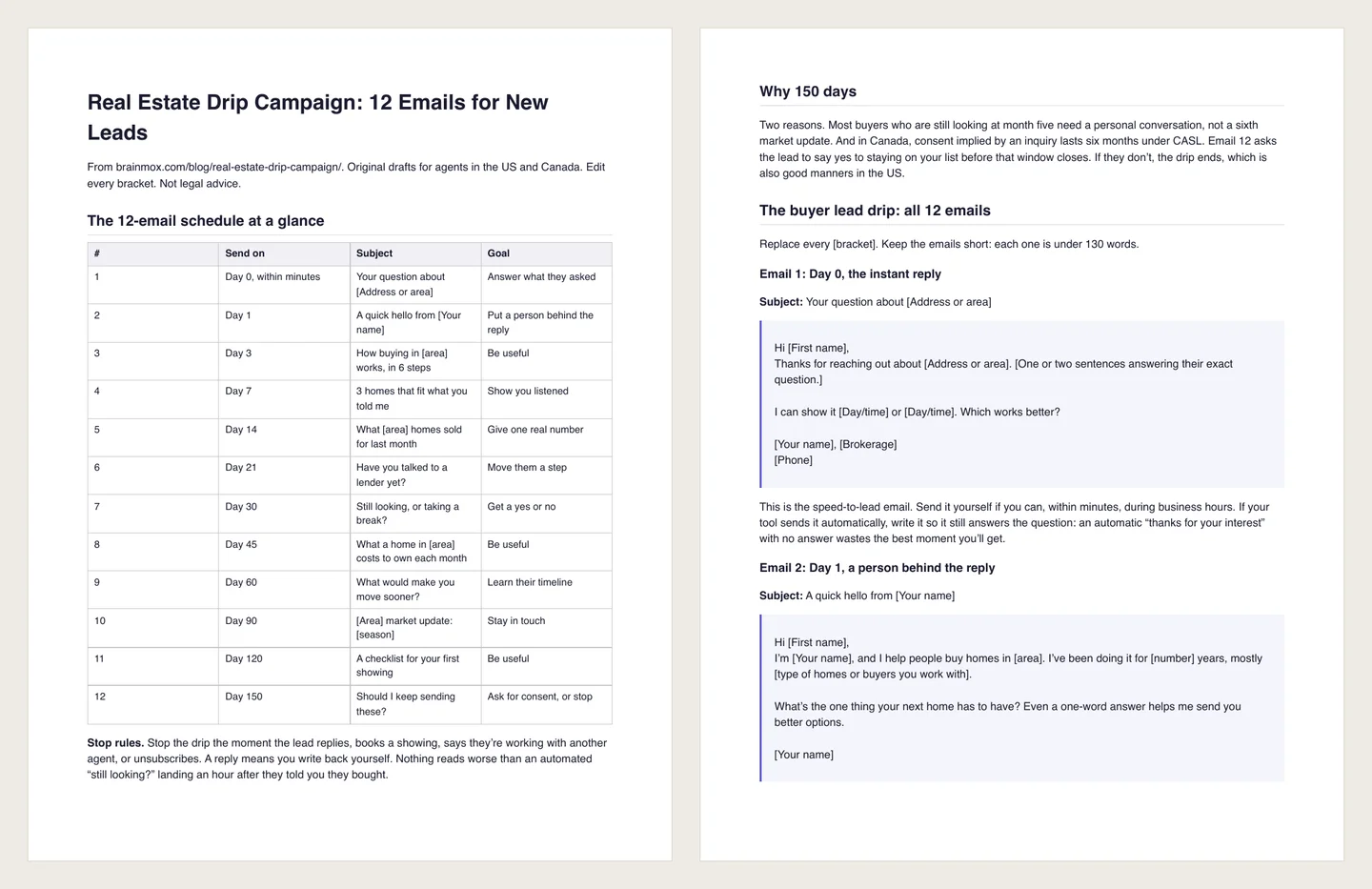
These are original drafts, written for agents in the US and Canada. We haven’t measured their open or reply rates. Edit every bracket, and read the whole sequence once as if you were the lead before you switch it on.
The 12-email schedule at a glance
| # | Send on | Subject | Goal |
|---|---|---|---|
| 1 | Day 0, within minutes | Your question about [Address or area] | Answer what they asked |
| 2 | Day 1 | A quick hello from [Your name] | Put a person behind the reply |
| 3 | Day 3 | How buying in [area] works, in 6 steps | Be useful |
| 4 | Day 7 | 3 homes that fit what you told me | Show you listened |
| 5 | Day 14 | What [area] homes sold for last month | Give one real number |
| 6 | Day 21 | Have you talked to a lender yet? | Move them a step |
| 7 | Day 30 | Still looking, or taking a break? | Get a yes or no |
| 8 | Day 45 | What a home in [area] costs to own each month | Be useful |
| 9 | Day 60 | What would make you move sooner? | Learn their timeline |
| 10 | Day 90 | [Area] market update: [season] | Stay in touch |
| 11 | Day 120 | A checklist for your first showing | Be useful |
| 12 | Day 150 | Should I keep sending these? | Ask for consent, or stop |
Stop rules. Stop the drip the moment the lead replies, books a showing, says they’re working with another agent, or unsubscribes. A reply means you write back yourself. Nothing reads worse than an automated “still looking?” landing an hour after they told you they bought.
Why 150 days
Two reasons. Most buyers who are still looking at month five need a personal conversation, not a sixth market update. And in Canada, consent implied by an inquiry lasts six months under CASL. Email 12 asks the lead to say yes to staying on your list before that window closes. If they don’t, the drip ends, which is also good manners in the US.
The buyer lead drip: all 12 emails
Replace every [bracket]. Keep the emails short: each one is under 130 words.
Email 1: Day 0, the instant reply
Subject: Your question about [Address or area]
Hi [First name],
Thanks for reaching out about [Address or area]. [One or two sentences answering their exact question.]I can show it [Day/time] or [Day/time]. Which works better?
[Your name], [Brokerage]
[Phone]
This is the speed-to-lead email. Send it yourself if you can, within minutes, during business hours. If your tool sends it automatically, write it so it still answers the question: an automatic “thanks for your interest” with no answer wastes the best moment you’ll get.
Email 2: Day 1, a person behind the reply
Subject: A quick hello from [Your name]
Hi [First name],
I’m [Your name], and I help people buy homes in [area]. I’ve been doing it for [number] years, mostly [type of homes or buyers you work with].What’s the one thing your next home has to have? Even a one-word answer helps me send you better options.
[Your name]
Email 3: Day 3, how buying works
Subject: How buying in [area] works, in 6 steps
Hi [First name],
Here’s the short version of how buying works here:
- Get pre-approved, so you know your budget.
- Agree how we’ll work together. [Mention your buyer agreement if your market requires one.]
- See homes and shortlist.
- Make an offer, with conditions that protect you.
- Inspection, financing and paperwork.
- Closing and keys.
Which step are you at right now?
[Your name]
Check step 2 against your local rules. Written buyer agreements are now standard in many US markets, and Canadian practice varies by province.
Email 4: Day 7, homes that fit
Subject: 3 homes that fit what you told me
Hi [First name],
You mentioned [criteria]. These three fit:
- [Address]: [one line on why]
- [Address]: [one line]
- [Address]: [one line]
Want to see any of them this week?
[Your name]
Send real listings, picked by you, on the day the email goes out. If your tool can’t do that, make this one a reminder to yourself instead of an automated email.
Email 5: Day 14, one real number
Subject: What [area] homes sold for last month
Hi [First name],
Last month in [area], [number] homes sold. The median price was [price], and the typical home sold in [number] days.If you’d like the same numbers for a smaller area or a certain type of home, just tell me which.
[Your name]
Source: [your board or MLS report, month]
Email 6: Day 21, the lender question
Subject: Have you talked to a lender yet?
Hi [First name],
A pre-approval tells you your real budget and makes your offer stronger when you find the right place. It also takes a few days, so it’s worth doing before you’re in a hurry.Have you started that yet? If not, I can share a couple of lenders my clients have worked with. You’re free to use anyone.
[Your name]
Email 7: Day 30, yes or no
Subject: Still looking, or taking a break?
Hi [First name],
It’s been a month since you asked about [Address or area]. Are you still looking, or taking a break for now?Either answer is fine. If it’s a break, I’ll send less.
[Your name]
This one gets the most honest replies, because it gives the lead an easy way out. More versions are in follow-up email after no response.
Email 8: Day 45, the monthly cost
Subject: What a home in [area] costs to own each month
Hi [First name],
The price is only part of it. For a [price] home in [area], the monthly costs usually include:
- Mortgage payment: [ask your lender for a number]
- Property taxes: about [amount] a month
- Insurance: about [amount] a month
- [Condo or HOA fees, if any]
Want me to run these numbers for a home you’ve seen?
[Your name]
Use real local figures or leave the line out. Don’t quote a mortgage payment yourself; send them to a lender.
Email 9: Day 60, their timeline
Subject: What would make you move sooner?
Hi [First name],
Some people I work with are waiting for a lease to end, a job to settle or the right school year. What’s the main thing that decides your timing?Knowing that helps me only send you what’s useful.
[Your name]
Email 10: Day 90, market update
Subject: [Area] market update: [season]
Hi [First name],
A quick look at [area] this [season]:
- Homes for sale: [number] ([up/down] from [number] last year)
- Median sold price: [price]
- Typical days on market: [number]
What it means for buyers: [one honest sentence].
Reply if you’d like to talk it through.
[Your name]
Source: [your board or MLS report, month]
Email 11: Day 120, a useful checklist
Subject: A checklist for your first showing
Hi [First name],
When you’re ready to see homes, here’s what to check that photos don’t show: water pressure, windows and doors, signs of water in the basement or under sinks, the age of the roof and furnace, and noise at the time of day you’d be home.Want me to send a printable version?
[Your name]
Email 12: Day 150, consent or stop
Subject: Should I keep sending these?
Hi [First name],
I’ve sent you a few emails since you asked about [Address or area] in [month]. I don’t want to fill your inbox if the timing isn’t right.If you’d like me to keep sending homes and market updates, reply “yes” or click here: [link]. If I don’t hear from you, this is my last email, and you’re always welcome to reach out later.
[Your name]
Keep the replies. A “yes” is a record of consent, and in Canada that’s what lets you keep emailing after six months.
Seller lead swaps
For someone who asked about selling or a home value, keep emails 1, 2, 7, 9 and 12 as they are, with “sell” for “buy”. Swap the rest:
| Seller version | |
|---|---|
| Email 3 · Day 3 | How selling in [area] works, in 6 steps (prepare, price, list, show, offers, close) |
| Email 4 · Day 7 | 3 homes near you that sold recently, with prices and days on market |
| Email 5 · Day 14 | What your home might sell for: offer to prepare a comparative market analysis, done by you, not an online estimate |
| Email 6 · Day 21 | 5 things buyers notice first in [area], and which ones are worth fixing |
| Email 8 · Day 45 | What selling costs: commission, legal fees, moving and prep, with ranges you've checked locally |
| Email 10 · Day 90 | Market update with the seller view: how many homes compete with theirs |
| Email 11 · Day 120 | A pre-listing checklist |
Never put a price on their home in an automated email. Price it after you’ve seen it.
Set it up in your email tool or CRM
- Make one list for new leads, with the date they first contacted you.
- Load the 12 emails with the send days from the CSV. Most CRMs and email tools call this a sequence, campaign or action plan.
- Turn on the stop rules: end the sequence on reply, booked appointment, unsubscribe, or a tag you add by hand (for example “working with another agent”).
- Send emails 4, 5 and 10 by hand, or as reminders to yourself. They need fresh listings and this month’s numbers.
- Send a test of each email to yourself and read it on your phone.
- Check once a week who replied and who unsubscribed.
US and Canada consent rules for drip emails
| Rule | United States (CAN-SPAM) | Canada (CASL) |
|---|---|---|
| Do you need consent first? | No, but every email must offer an opt-out | Yes: express, or implied |
| Implied consent from a lead's inquiry | n/a | Lasts 6 months from the inquiry |
| Every email needs | Accurate sender details, a non-deceptive subject, a valid postal address, an opt-out | Your name and brokerage (if sending for it), contact details, an unsubscribe |
| Opt-out deadline | Honour within 10 business days | Honour within 10 business days |
Sources: FTC CAN-SPAM Act compliance guide and Canada’s Anti-Spam Legislation, sections 6, 10 and 11. This is a practical summary, not legal advice. Your brokerage’s rules and your regulator come first.
When a lead replies: write back yourself
The drip’s only job is to get a reply. When one comes, read what they said and answer it personally, the same day. For ready replies to common situations, use the real estate email templates. For ChatGPT prompts that draft a reply from your notes, see ChatGPT for real estate agents.
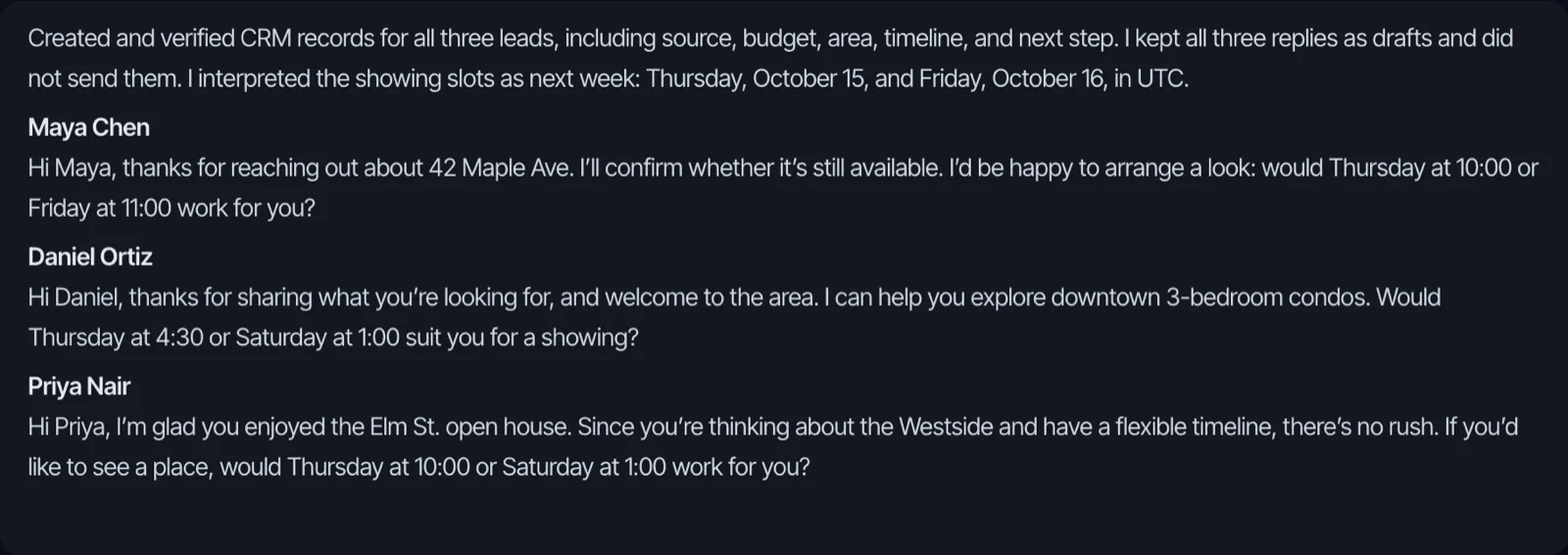
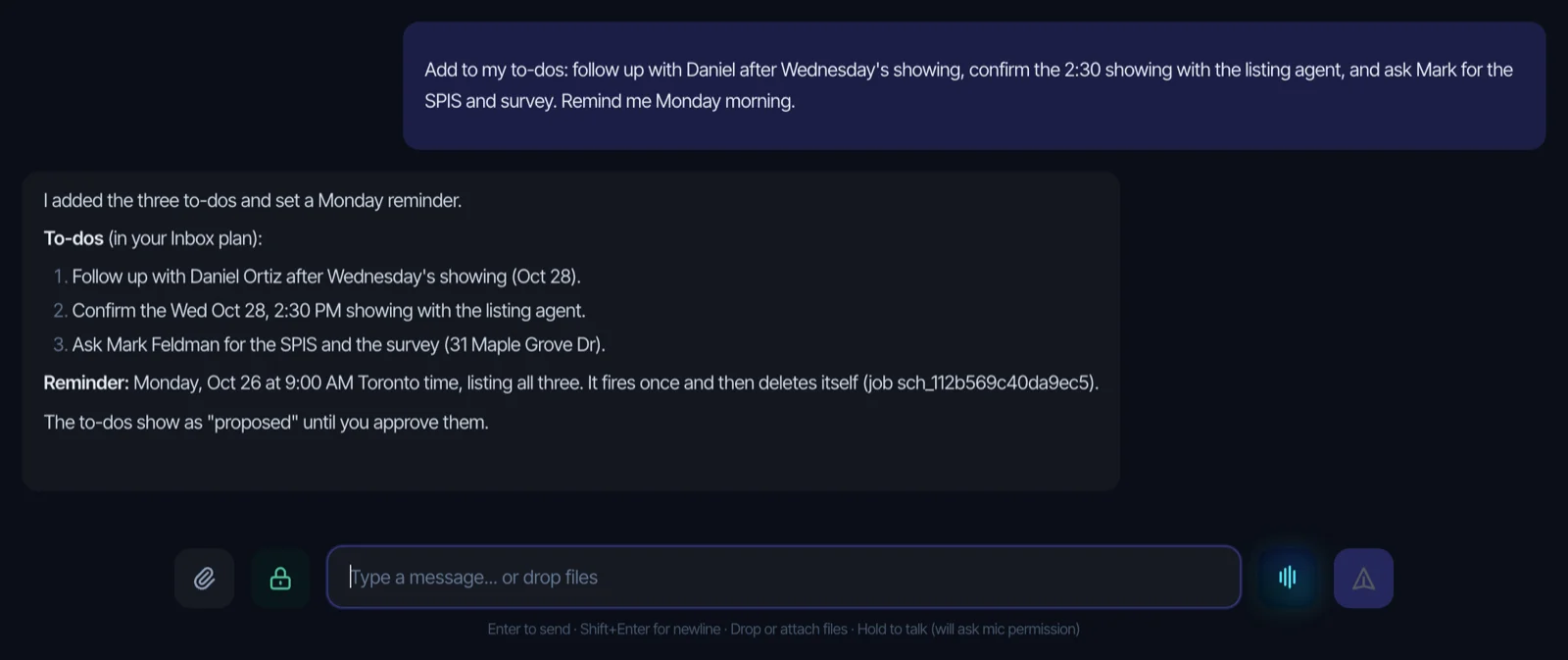
Brainmox can help with that part. It’s your own AI agent, set up with you by a person on our team: it drafts the personal reply in your Gmail or Outlook from what it remembers about the lead (with draft-only access, you send it), keeps your follow-up list, and reminds you when emails 4, 5 and 10 need fresh listings and numbers. It doesn’t run the drip itself, send texts or sync with your CRM. See how it works for real estate agents.
FAQ
What is a drip campaign in real estate?
A series of emails sent automatically to a lead on a schedule, usually from a CRM or email tool. It keeps you in touch with people who aren’t ready yet, and it should stop when they reply.
How many emails should a real estate drip campaign have?
Enough to cover the time a lead usually takes to get ready, without crowding their inbox. This plan uses 12 over 150 days: four in the first week, then one every two to four weeks.
How often should you email real estate leads?
Often in the first week, when they’re most likely to answer: day 0, 1, 3 and 7 in this plan. After that, every two to four weeks is plenty for most leads.
Do I need permission to send a drip campaign?
In the US, no, but every email must include an opt-out and a postal address. In Canada, yes: a lead’s inquiry gives you implied consent for six months, and after that you need their express consent, which is what email 12 asks for.