
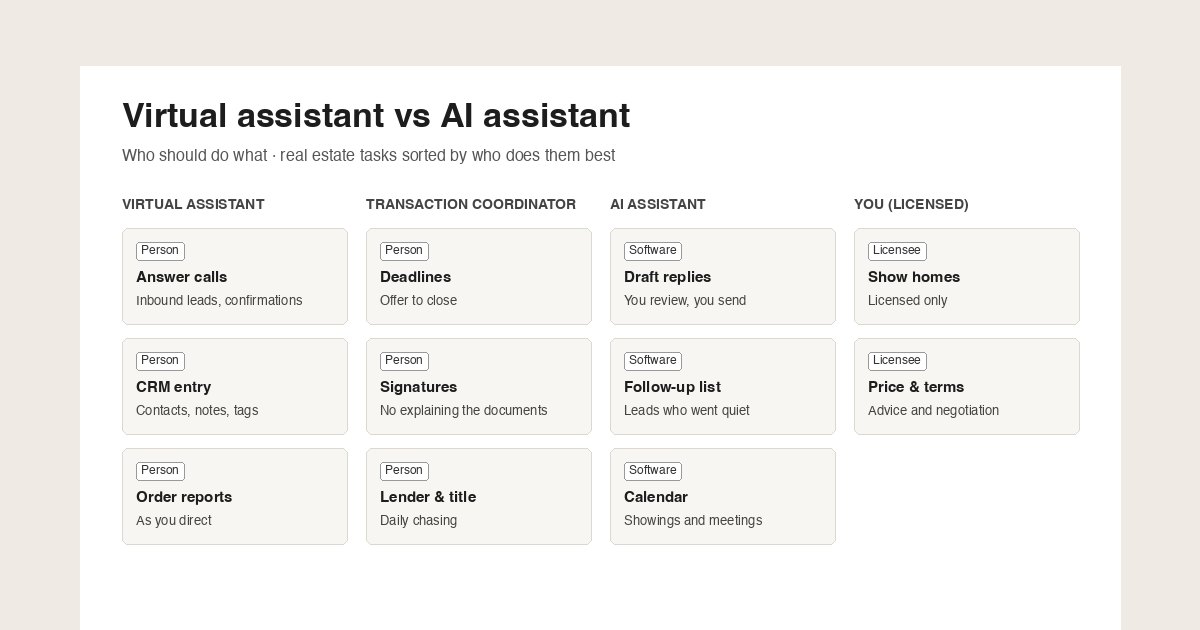
A real estate virtual assistant is a person who works remotely on your admin, calls and paperwork. An AI assistant is software that drafts emails, sorts your inbox, keeps your calendar and reminds you of follow-ups. A VA is better at anything that needs a phone call, judgement about a person or hands in a transaction. An AI assistant is better at volume work that happens at odd hours and needs your review anyway. Neither can do licensed work: showing homes, giving advice on a property or negotiating stays with you.
For most solo agents, the useful split looks like this: AI for email and calendar admin, a VA or transaction coordinator for phone and file work, and you for anything that needs a license.
The split that works for most solo agents
AI assistant
Writing and remembering
- Sort the inbox, flag what needs you
- Draft replies and follow-ups
- Book meetings in your calendar
- Follow-up lists and reminders
- First drafts of listing copy
VA or transaction coordinator
Phone and file work
- Answer calls, route leads
- CRM data entry
- Order inspections and reports
- Documents and signatures
- Chase lenders and title by phone
You
Anything that needs a license
- Show homes
- Advice on a property
- Price, terms and negotiation
- Approve what goes to clients
Drafts from the AI and the VA come back to you before anything client-facing goes out.
VA vs transaction coordinator vs AI assistant at a glance
| Compare | Virtual assistant | Transaction coordinator | AI assistant |
|---|---|---|---|
| What it is | A remote person, hourly or part-time | A person or service that runs files from accepted offer to close | Software you instruct in plain language |
| Best at | Calls, inbox, CRM entry, scheduling, marketing tasks | Deadlines, documents, signatures, talking to lenders and title | Drafting emails, follow-up lists, calendar, summaries, first drafts of listing copy |
| Phone calls | Yes | Yes | Depends on the tool. Brainmox doesn't make or take calls |
| Hours | Their working hours, often a different time zone | Business hours | Any time you message it |
| Training needed | Weeks: your scripts, systems, tone | Days: your brokerage's forms and checklist | Days: your writing style, clients, rules |
| Main risk | Turnover, access to your accounts, time zones | Missed deadline if handoff is unclear | Confident drafts with wrong facts if nobody reviews them |
| License limits | Same as any unlicensed assistant (see below) | Many are unlicensed; check your state or province | Can't hold a license. Everything client-facing needs your review |
What does a real estate assistant do?
A real estate assistant handles the work around a sale so the agent can spend time with clients. The usual duties are:
- Inbox and phone: answering inquiries, routing leads, confirming appointments.
- Calendar: booking showings, inspections and client meetings.
- Database: entering leads and contacts into the CRM and keeping notes current.
- Marketing: drafting listing descriptions, social posts, flyers and newsletters for your approval.
- Transaction support: tracking deadlines, collecting documents, ordering reports and sending files for signature.
- Follow-up: after open houses, past clients, and leads who went quiet.
In-house assistants do the same work on site, plus open house setup and errands. A VA does it remotely. An AI assistant covers the email, calendar, drafting and reminder parts of the list.
What an unlicensed assistant can and can’t do
Most VAs, and every AI tool, are unlicensed. The rules are set by each state and province, so check yours with your broker. Two examples show how far apart they can be.
California. The Department of Real Estate’s Guidelines for Unlicensed Assistants lists work an unlicensed assistant may do with the broker’s knowledge and consent: prepare a comparative market analysis for the licensee, schedule appointments, order inspections and reports, prepare documents that a licensee reviews before they go out, deliver documents and collect signatures (without discussing what they mean), and greet people and hand out approved material at an open house. Only a licensee may show the property or discuss terms, the neighborhood or schools.
Ontario. RECO’s bulletin on registered and unregistered assistants says an unregistered assistant can’t do anything that counts as trading. Its examples include being on site at open houses, door knocking, phone solicitation, showing properties and taking part in an offer or listing presentation. Behind-the-scenes admin is fine.
What an unlicensed assistant may do: two examples
California: CA DRE guidelines; "limited" means general-interest canvassing with referral to a licensee. Ontario: RECO bulletin, unregistered assistants. Not legal advice; check your regulator and broker.
So a task that’s normal for a California VA, such as greeting visitors at an open house, isn’t allowed for an unregistered assistant in Ontario. This page isn’t legal advice. Your brokerage’s policy and your regulator’s current rules decide.
Task-by-task: who should do what
“VA” here means an unlicensed remote assistant. “AI” means an AI assistant with access to your email and calendar. “You” means a licensee.
| Task | You | VA | TC | AI | Notes |
|---|---|---|---|---|---|
| Sort the inbox and flag what needs you | ✓ | ✓ | AI is fast here; a VA catches tone and context better | ||
| Draft replies to inquiries | Approve | ✓ | ✓ | Facts about a property come from you or your listing sheet | |
| Follow up with leads who went quiet | Approve | ✓ | ✓ | See our follow-up email templates | |
| Open house follow-up emails | Approve | ✓ | ✓ | Email only people who agreed to it (sign-in sheet) | |
| Answer inbound calls | ✓ | Brainmox doesn't take calls | |||
| Cold calling and prospecting | ✓ | Limited | California allows general-interest canvassing with referral to a licensee; Ontario doesn't allow phone solicitation by unregistered assistants | ||
| Book showings and meetings | ✓ | ✓ | Confirm the client's time zone and access instructions | ||
| Show a property | ✓ | Licensed only | |||
| Host an open house | ✓ | CA: greet only | Ontario: unregistered assistants can't be on site | ||
| Prepare a CMA | Approve | ✓ | Draft | California lets an unlicensed assistant prepare it for your use | |
| First draft of listing description | Approve | ✓ | ✓ | Check every feature claim against the property | |
| Social posts and newsletter drafts | Approve | ✓ | ✓ | ||
| CRM data entry | ✓ | Limited | Brainmox has no CRM sync; it can work in web-based tools in its own browser | ||
| Track transaction deadlines | ✓ | ✓ | Reminders | The TC owns the file; AI can remind you | |
| Order inspections and reports | ✓ | ✓ | As directed by the licensee | ||
| Prepare documents | Review | ✓ | ✓ | A licensee reviews before anything goes to a client | |
| Collect signatures | ✓ | ✓ | No explaining what the document means | ||
| Discuss price, terms or negotiate | ✓ | Licensed only | |||
| Meeting notes and to-do lists | ✓ | ✓ | Our action-items template works for both |
The pattern: AI handles the writing and remembering, people handle calls and transaction work, and you keep anything that’s advice, negotiation or showing a home.
Real estate virtual assistant cost vs AI assistant cost
Here’s the monthly math for 20 hours a week (about 87 hours a month).
Monthly cost at 20 hours a week
Striped part = the advertised range. Your own time for training and review isn't in these numbers. Sources in the table below.
| Option | Rate | Monthly at 20 h/week | Source |
|---|---|---|---|
| Offshore VA agency | $4 to $8 an hour, as advertised | about $350 to $690 | Rate shown in Bruntwork's Google listing, October 2026 |
| US real estate assistant | $20.61 an hour average | about $1,790, before payroll costs | Indeed figure quoted by NAR, August 2026 |
| AI assistant (Brainmox) | flat | $299 a month, private-beta price ($2,990 a year) | Brainmox pricing |
A few things the table doesn’t show:
- A VA’s real cost includes your time. Training, checking work and covering their days off all come out of your week, especially in the first month.
- Agency rates vary a lot with hours, location and whether the VA is shared. Ask what’s included and who covers holidays.
- An employee costs more than the hourly wage. In the US and Canada, payroll taxes and benefits add to it. A contractor arrangement has its own rules; ask your accountant.
- An AI assistant still needs you. It drafts, you review and send. If you don’t have 15 minutes a day to review drafts, it won’t save you much.
When an AI assistant is the wrong choice
- Your leads mostly call or text, and you need someone to answer live.
- You need someone on site: lockboxes, signs, staging, errands.
- Your files need a person chasing lenders and title by phone every day. Hire a TC.
- You won’t review drafts before they go out. Unreviewed AI email to clients is a bad idea.
When a VA is the wrong choice
- Most of the work is writing: replies, follow-ups, listing drafts, newsletters.
- The work happens at night and on weekends, when a VA is off.
- You’ve lost VAs before and don’t want to retrain someone every few months.
- You aren’t comfortable giving a person full access to your inbox. An AI tool with draft-only email access is a narrower option.
Three setups that work
Solo agent
10 to 20 deals a year
- AI assistant
- Inbox, follow-up and calendar.
- People
- Pay a TC per file when you're under contract.
- You
- Calls and showings.
Busy solo agent
20 to 40 deals a year
- AI assistant
- Drafting and reminders.
- People
- A part-time VA for calls, CRM entry and scheduling. A TC for files, or the VA if they're trained on your forms.
- You
- Showings, advice and negotiation.
Small team
Several agents
- AI assistant
- One for each agent's own inbox and follow-up.
- People
- One in-house or full-time VA as the operations person, and a TC for files.
- Agents
- Showings, advice and negotiation.
Before you hand anything over
Whether it’s a person or software, set these up first:
- Write down what they may do alone, what needs your OK, and what’s off limits. Use the matrix above and your regulator’s rules.
- Give the narrowest access that works. Separate logins where you can. Draft-only email access if the tool offers it.
- Check consent. Email or text only people who agreed to it. Your sign-in sheet and CRM should record that.
- Review client-facing messages for the first two weeks, then spot-check.
- Keep one task list that you, the VA and the AI all work from, so nothing falls between them.
Copy this delegation brief
The same brief works for a new VA and for an AI assistant. Fill it in once per recurring task. The example is fictional.
Delegation brief
Task: Open house follow-up emails
When: The evening of each open house, by 8 pm
Input: Sign-in sheet export (CSV) and my notes on each visitor
Do alone: Draft one email per visitor who ticked “OK to email”
Needs my OK: Every draft, before it’s sent
Never: Email anyone who didn’t tick the box. Give prices, school details or opinions on the neighborhood. Promise a showing time I haven’t confirmed
Tone: Short, friendly, mention one thing they said. Sign as me
Done when: Drafts are in my Gmail drafts folder and the list shows who got one
Example: “Hi Jordan, thanks for coming by 14 Maple Street today. You asked about the backyard; the lot is [size from listing sheet]. Want me to send the disclosure package?”
Writing it down forces you to decide where the license line sits for that task. It also makes the first two weeks of review much faster, because you check the work against the brief instead of your memory. For the email wording itself, use our open house follow-up templates.
Where Brainmox fits
Brainmox is your own AI agent, set up with you by our team. It works in Gmail in draft-only mode, so it writes drafts and you send them. It adds and updates events in Google Calendar, keeps follow-up lists and reminders, and remembers your clients and how you write. You talk to it in the desktop app, the web app, Telegram, Slack or WhatsApp. It works in web-based tools in its own browser.
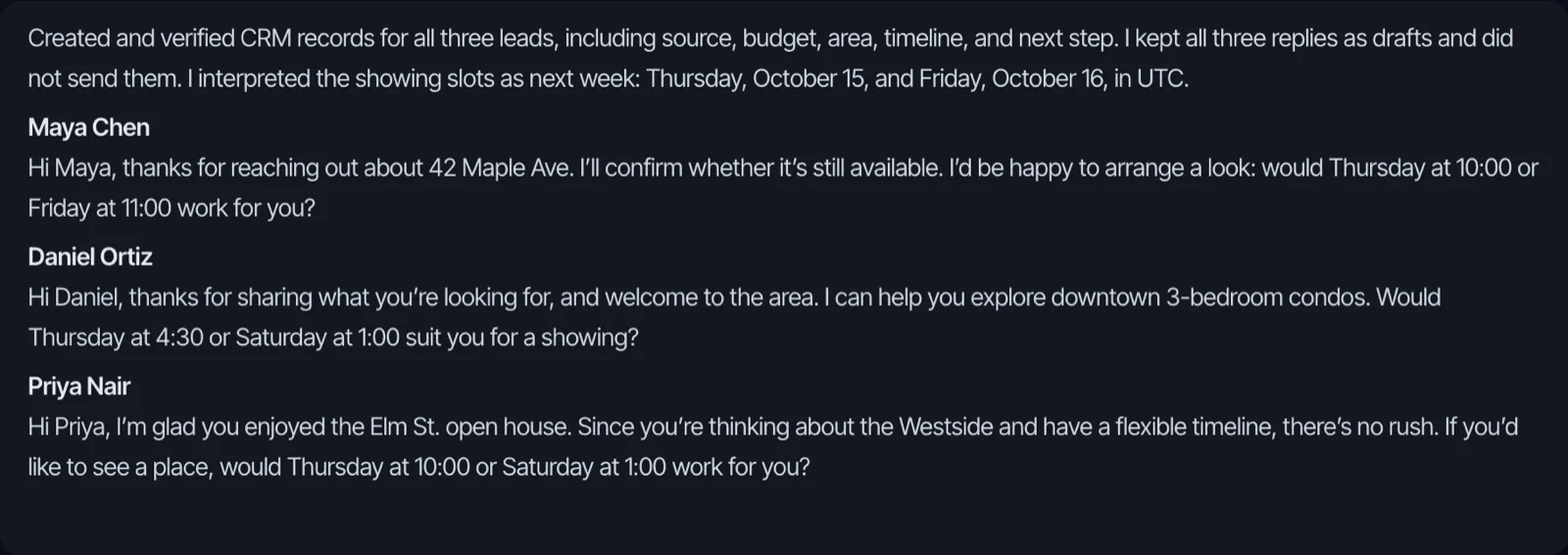
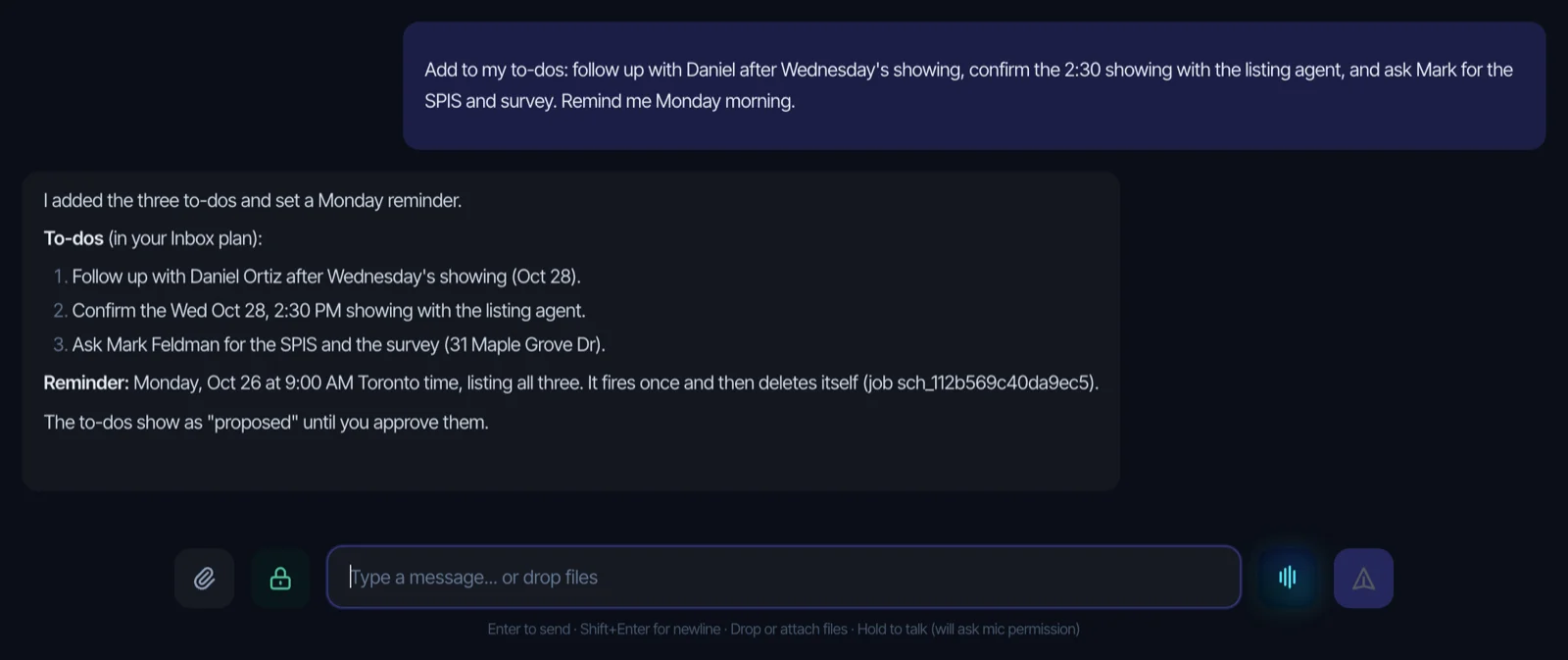
It doesn’t make or answer phone calls, text leads or sync with your CRM, so it doesn’t replace a VA or TC for that work. It’s in private beta in the US and Canada at a private-beta price of $299 a month. See how Brainmox works for real estate agents or the Gmail drafting walkthrough for real saved drafts.
FAQ
Can a real estate virtual assistant work without a license?
Yes, for admin work such as email, scheduling, CRM entry and document prep that a licensee reviews. Anything that counts as licensed activity in your state or province, such as showing homes or discussing terms, needs a licensee. Ontario is stricter than California on open houses and phone solicitation.
Can an AI assistant replace a real estate assistant?
For writing, inbox sorting, reminders and calendar work, it can cover a lot of what an assistant does. It can’t answer the phone (in Brainmox’s case), be on site or run a transaction file by phone. Most agents who use one still need a person for some of the work.
How much does a real estate virtual assistant cost?
Offshore agencies advertise $4 to $8 an hour. The US average for a real estate assistant was $20.61 an hour in August 2026, per Indeed as quoted by NAR. At 20 hours a week, that’s roughly $350 to $1,790 a month before other costs.
What should I delegate first?
Start with follow-up emails and calendar booking. Both are frequent, easy to check and don’t need a license. Move to CRM entry and transaction tracking once the first handoff runs smoothly.
Should my VA have access to my email?
Only if their job needs it, and with the narrowest access possible. Use delegated access or a shared inbox instead of your password. For AI tools, choose draft-only access where it’s offered.
Sources
- California Department of Real Estate, Guidelines for Unlicensed Assistants who Work in the Real Estate Industry (dre.ca.gov, PDF), checked October 2026.
- Real Estate Council of Ontario, Registrar’s Bulletin, Registered/Unregistered Assistants Trading in Real Estate (March 7, 2012; no longer on reco.on.ca as of October 2026). Ontario now operates under the Trust in Real Estate Services Act, 2002 (TRESA); confirm current details with RECO or your broker of record.
- NAR, Personal Assistants page, quoting Indeed’s average real estate assistant pay of $20.61 an hour (August 2, 2026).
- Bruntwork, real estate virtual assistant page, advertised rate of $4 to $8 an hour (October 2026).