Product

Brainmox, your AI agent
for the recurring work of your business.

It drafts your emails, keeps your follow-ups and deadlines in view, and prepares reports and documents, while remembering your clients and how you work. We set it up and keep it tuned. You review what goes out.

Our own AI agent technology, set up and supported by our team · Desktop and web apps · Private beta

$299 USD/month or $2,990/year. One assistant, with supported usage included under beta limits. Signup requires an invitation code; join the waitlist to request one.

/ Before you choose

Start with the work.
Check the fit.

01

Bring one recurring responsibility

A weekly report, meeting follow-up list or queue of email drafts gives you a concrete output to judge. Brainmox is a fit to evaluate when that work needs context across sessions and more than one supported tool.
02

Configure the sources and review

Guided onboarding helps you connect supported accounts and choose tool permissions. Start with selected files and the access your task needs. Agree on the output, schedule, timezone and who checks it.
03

Evaluate a complete result

Open the delivered file or saved draft, check facts against the source and ask for a correction. Review the next run before expanding the scope. For occasional writing or calendar time blocking alone, a narrower tool may be sufficient.

Check included usage and beta terms and data handling and security before choosing your first workflow.

/ Inside Brainmox

See Brainmox
at work.

Real private-beta screens from a demo account. No conceptual mockups.

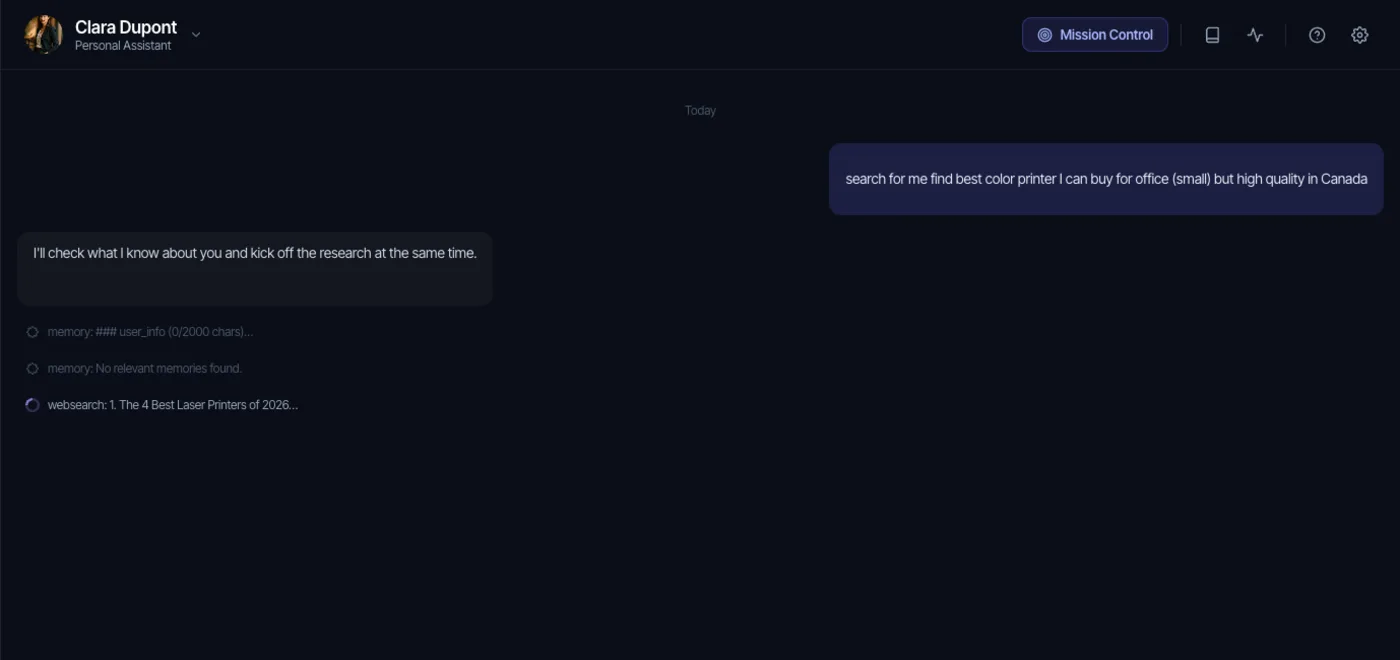
Brainmox conversation showing Clara checking memory and running web research for an office printer request Open full-size
/ Work in progress

See what your assistant is doing.

The conversation shows memory lookup and web research while the task is running, instead of hiding tool activity behind a generic loading state.
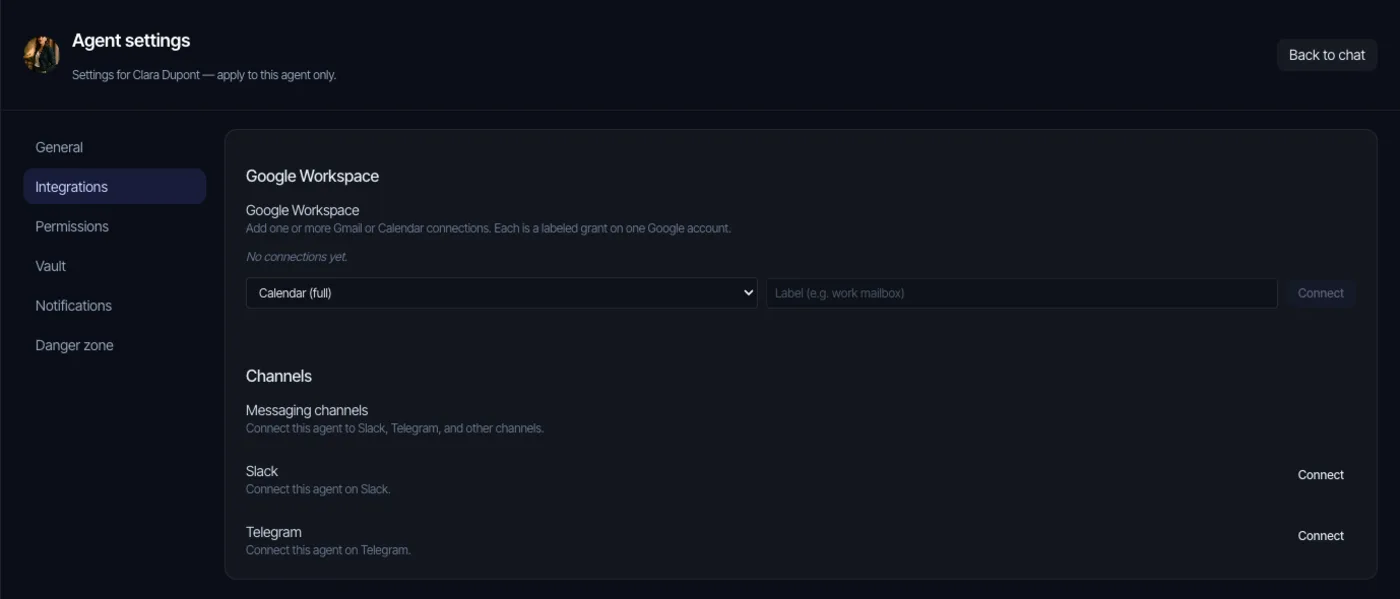
Brainmox agent settings showing Google Workspace, Slack, and Telegram connection controls Open full-size
/ Connected work

Connect services per assistant.

Agent settings expose Google Workspace and messaging-channel connections alongside separate permissions and vault controls.

/ Start with one task

What would you
hand over first?

01

Turn notes into next steps

Ask for an action list with owners, due dates and unresolved questions. Compare the result with your notes before assigning work.
Get the action-items template and see the test →
02

Prepare replies for review

Connect Gmail with draft-only access to prepare replies from thread context. Check recipients, facts and attachments before you send. The draft-only tool setting blocks sending; it does not mean the underlying Google permission grant cannot send.
See the saved Gmail drafts →
03

Build a recurring report

Bring together source files and project updates in a report or spreadsheet. Set a recurring schedule when the sources and instructions are ready, then check the result for omissions and unsupported conclusions.
Inspect the report and original files →

Choosing how to delegate a recurring task? Compare agents, chatbots and copilots →

Delegating briefings and administrative follow-ups? Compare AI executive assistants and recurring workflows →

Choosing an assistant for your work? Compare tools by task and cost →

Deciding who should operate your assistant? Compare OpenClaw with managed alternatives →

/ Capabilities

What your assistant
can actually do.

It has an identity.
Generated with a name, bio, personality, avatar, and voice. The configured identity stays consistent across supported channels.
It has long-term memory.
Carry relevant preferences, decisions, and project context across sessions. Search and review saved knowledge in the app, with new memories appearing while the panel stays open.
It works with files end to end.
Open, create, edit, copy, move, and search workspace files, including Word, Excel, PowerPoint, and PDF documents. Finished files can be delivered directly in chat for download.
It keeps structured records.
Maintain CRM records for contacts and businesses, link related records, and update a specific existing record. Add or hide fields as your work evolves; permanently removing a field and its values requires confirmation.
It browses the real web.
Full page reads, not just search snippets. JavaScript-heavy apps and headless-browser automation when a site needs real interaction.
It searches professionally.
Web, news, image, place, shopping, scholarly, maps, and weather tools are available when enabled for the agent.
It runs shell commands.
A hardened sandbox with a command validator that blocks dangerous patterns before they reach your system.
It generates images.
Create images from a description, or edit a photo saved in its workspace, rendered inline in the conversation.
It extracts from PDFs.
Drop a contract, report, or invoice. It reads, summarizes, and acts.
It works across connected accounts.
Connect Gmail, Calendar, Drive, Sheets, Docs, Contacts, Tasks, and Dropbox with the access level you grant. Gmail includes a draft-only option so your assistant can prepare messages without sending them.
It messages everywhere.
Same agent, same memory, on Telegram, Slack and WhatsApp as well as the desktop and web apps. Reach it wherever you already work.
It runs on a schedule.
Set one-time reminders or recurring briefings and inbox reviews. Local-time reminders account for daylight-saving rules on the requested date; review the output and permissions for each workflow.
It runs real projects.
Mission Control organizes plans, tasks, deliverables, and status history. Choose approval and autonomy settings, review finished work, and send a task back with instructions when it needs changes.
It delegates.
For bounded research or specialized tasks, it can assign a subtask to a child agent and return the result to the main run.
/ A workflow example

See a real workflow.

We gave Brainmox five fictional meeting notes, then clarified an owner and a deadline. Compare the original and revised CSVs to see exactly what changed.

Founder-run test with fictional data.

Get the template and read the test
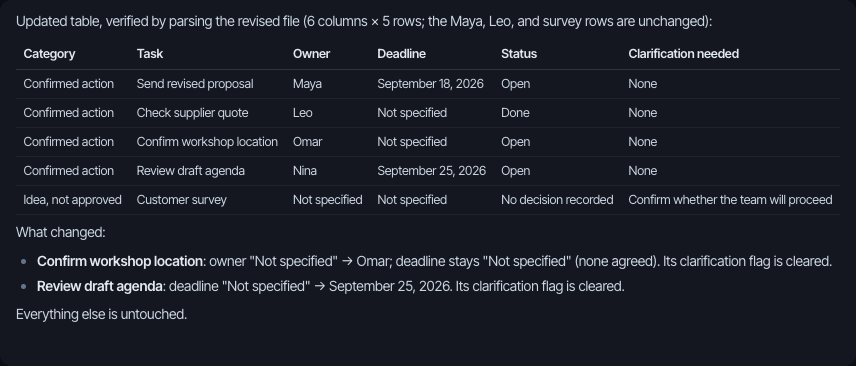
Brainmox's revised action table, naming Omar as workshop owner and September 25 as Nina's deadline.
Actual response from the test. Open the screenshot to read it full-size.
/ Set the boundaries

Keep context.
Review the work.

01 Memory: save relevant preferences, decisions and project context across sessions. Search and review saved knowledge, and remove information you no longer want retained. Check important facts against current sources.
02 Schedules: set one-time or recurring work with an explicit timezone. Define where the result should appear and inspect the output; a schedule is not a guarantee that every source will be available.
03 Connections: use supported Google Workspace services and Dropbox with the access you grant. Gmail draft-only mode blocks sending through the assistant's tools; the underlying Google permission grant is broader.
04 Review: Mission Control organizes plans, tasks, deliverables and status history. Choose the available approval settings and send work back with instructions when it needs changes.
05 Visibility: review activity records and tool calls to understand the work performed. Verify the finished artifact before sending it to a client or relying on a commitment.
06 Data and runtime: Brainmox is a managed cloud service. An optional local tool runtime can work with your computer's files and tools; AI processing remains in the cloud. Review the Security page before connecting sensitive work.
/ Your desktop

Your assistant
lives on your desktop.

A desktop app for macOS, Windows, and Linux — plus a web app in any browser. System tray integration, native notifications, and a clean chat UI.

Persistent conversation spaces: rename, color-tag, organize work, and review another space read-only while your assistant is busy elsewhere.
A live Screen in the sidebar shows the commands your assistant runs, the pages it searches and reads, and its browser as it works, while chat shows a one-line status. Click it for a larger view.
A notification center collects reminders, scheduled results and background-task updates, with snooze and archive.
Ask a question with push-to-talk and hear the reply in your assistant's selected voice in desktop or web chat. A written answer remains available if audio cannot play; Telegram also supports voice replies. Ask for a script read aloud and get a playable audio clip in chat.
Desktop notifications identify which assistant responded when work finishes or a channel message arrives.
Drag-and-drop file handling in chat, routed by file type to context or the agent workspace.
Optional launch at login from the tray on macOS, Windows, and Linux.

Put a workflow to the test

Start with a bounded task, inspect the result and keep your review part of the process.

Explore Gmail reply drafting · Browse practical workflows

/ See it running

Choose a workflow.
Review the fit.

Private-beta signup requires an invitation code. Join the waitlist and review current pricing and how access works; guided onboarding helps you configure your assistant, connected accounts and permissions for the work you choose.